0101 · An essay on time, told in the order it happened
How we learned to draw time
Nobody has ever seen time. We have seen shadows move, water fall, stars wheel and bells swing. Out of those we built two shapes that now feel like the thing itself, a circle that comes back around and a grid that fills up. This essay follows how those shapes got chosen. It runs as a timeline, which is a third shape, and the youngest of the three.
Before the story · eleven objects
Things people made to hold time
Stone, water, brass, iron, ink. Every one of these objects takes a position on what time looks like, long before anyone wrote the theory down. Scroll to turn the ring, or drag it.
Chapter I c. 30,000 – 8,000 BCE
The notch
The first record of time may be a scratch. On bones carved in Ice Age Europe, small marks appear in rows and clusters. Some archaeologists read them as tallies of the moon’s phases. Others see decoration. Either way, someone made one mark, then another, and the marks stayed.
A notch stays put. The next one goes beside it.
This is the oldest idea in the essay, and the plainest. Time can be kept by adding things. A calendar with days crossed off and a progress bar crawling across a screen both work the way the bone does.
At Warren Field in Scotland, people dug a row of twelve pits around 8,000 BCE. Researchers think the row tracked the phases of the moon and was corrected each winter by the sunrise. Twelve, already. The number keeps turning up, in the next chapter and on your wrist.
Chapter II c. 2000 BCE · Mesopotamia
Sixty
Babylonian scribes counted in base sixty. You still do, every time you read a clock or a compass. Sixty is a generous number. It divides evenly by 1, 2, 3, 4, 5, 6, 10, 12, 15, 20 and 30. Ten divides by 2 and 5.
One theory places its origin in the hand. Touch your thumb to the three segments of each of your four fingers and you count twelve. Keep track of each dozen on the five fingers of the other hand and you reach sixty.
Greek astronomers adopted the system to measure angles in the sky. In medieval Latin the first small division of a degree became pars minuta prima, the first small part, and the next pars minuta secunda, the second.
The minute was cut from a degree of arc. Applying it to the hour came later.
Chapter III c. 1500 BCE · Egypt
The ground was the first dial
Egyptian shadow clocks laid a marked bar along the ground and let the shadow of a raised crossbar fall across it. The bar kept no time of its own. It took the position of the sun and turned it into a place on the ground you could point at.
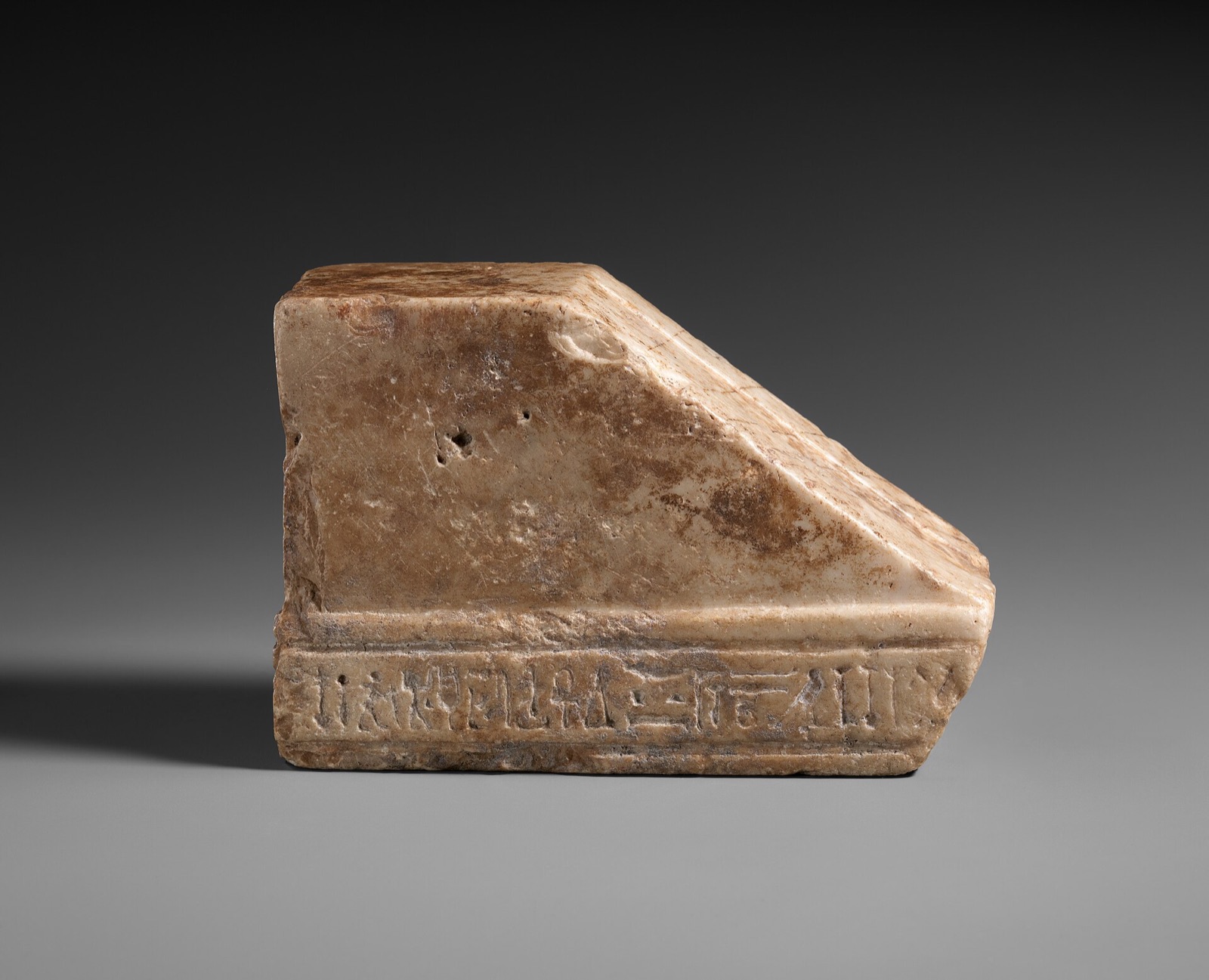
Everything after this depends on that move. A sundial lets you look at time, as a position along a line or around a point. Once time is a place, you can draw it, and drawing it is what the rest of these chapters are about.
It also explains which way the hands go round.
On a horizontal sundial in the northern hemisphere, the shadow sweeps from west, through north, to east. Scroll and watch it go. When mechanical dials appeared in Europe they copied the motion people already trusted from the sundial, so the word we use for it, clockwise, is really describing a shadow.
Chapter IV c. 1400 BCE · Karnak
Hours used to stretch
A sundial is useless at night. At Karnak, a stone vessel let water seep out through a small hole near its base, and rows of marks inside showed how far the level had dropped. The water kept falling after sunset.
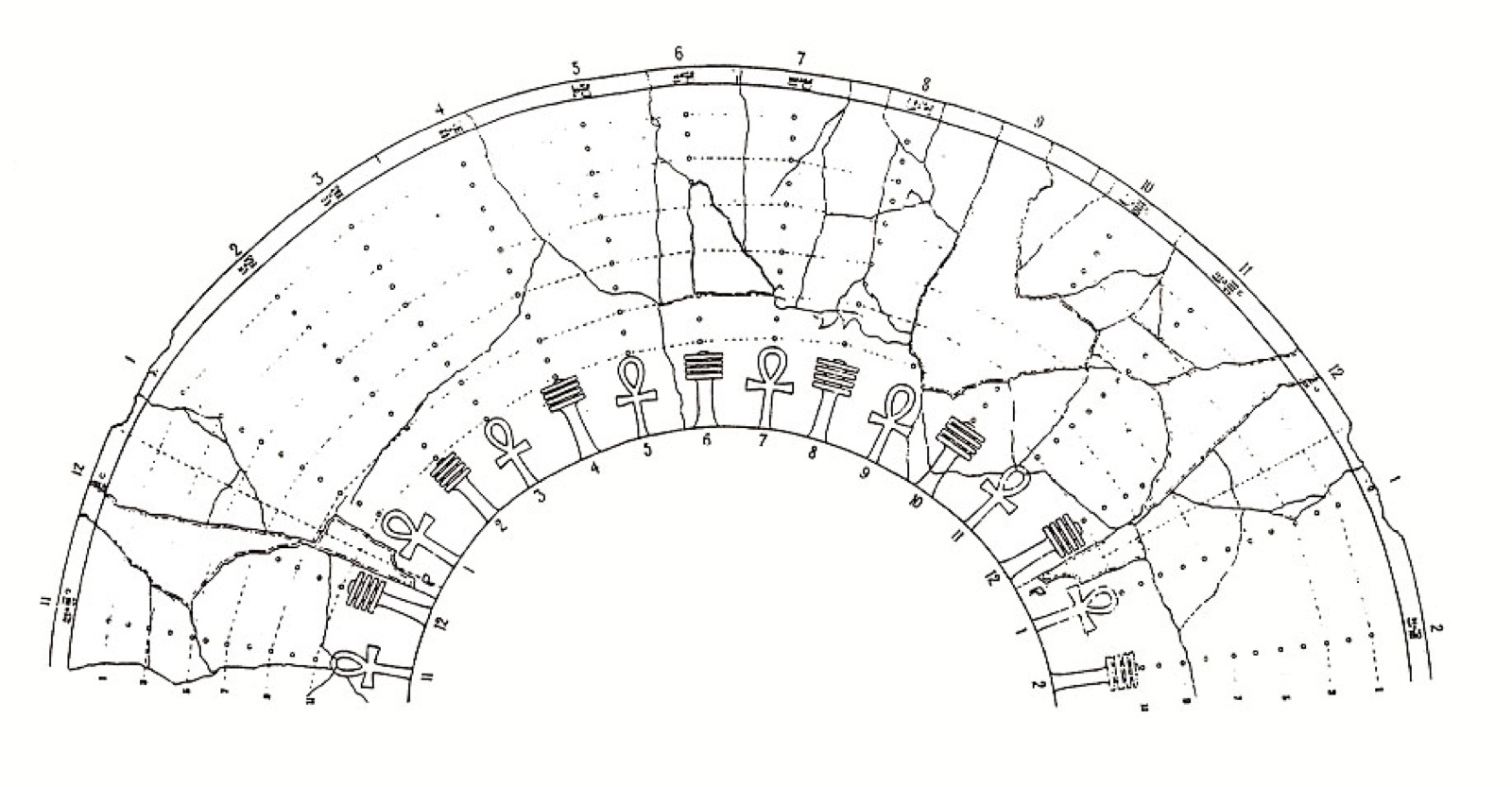
An hour then changed length with the month. Egyptians divided the daylight into twelve parts and the night into twelve parts, whatever the season. In summer a daytime hour was long and a night hour short. The Karnak vessel carried a separate scale for each month.
Try it on the right. Pick a city, drag the season, and watch twelve hours of daylight swell and shrink.
Equal hours are younger than most cathedrals.
Seasonal hours stayed in common use for some three thousand years. Hours of one fixed length entered everyday European life only in the fourteenth century, with the mechanical clock. Uniform time had to be manufactured by a machine before anyone could take it for granted.
What then is time? If no one asks me, I know.
Augustine of Hippo, Confessions, Book XI, c. 400 CE
Chapter V c. 60 BCE – 321 CE · Rome
Days became a table
The day got drawn as a turning. The year, for a long time, got drawn as a list. Romans painted calendars on walls as tables: a column for each month, a row for each day. Every day carried a letter from A to H, tracking an eight-day cycle of markets called the nundinae.
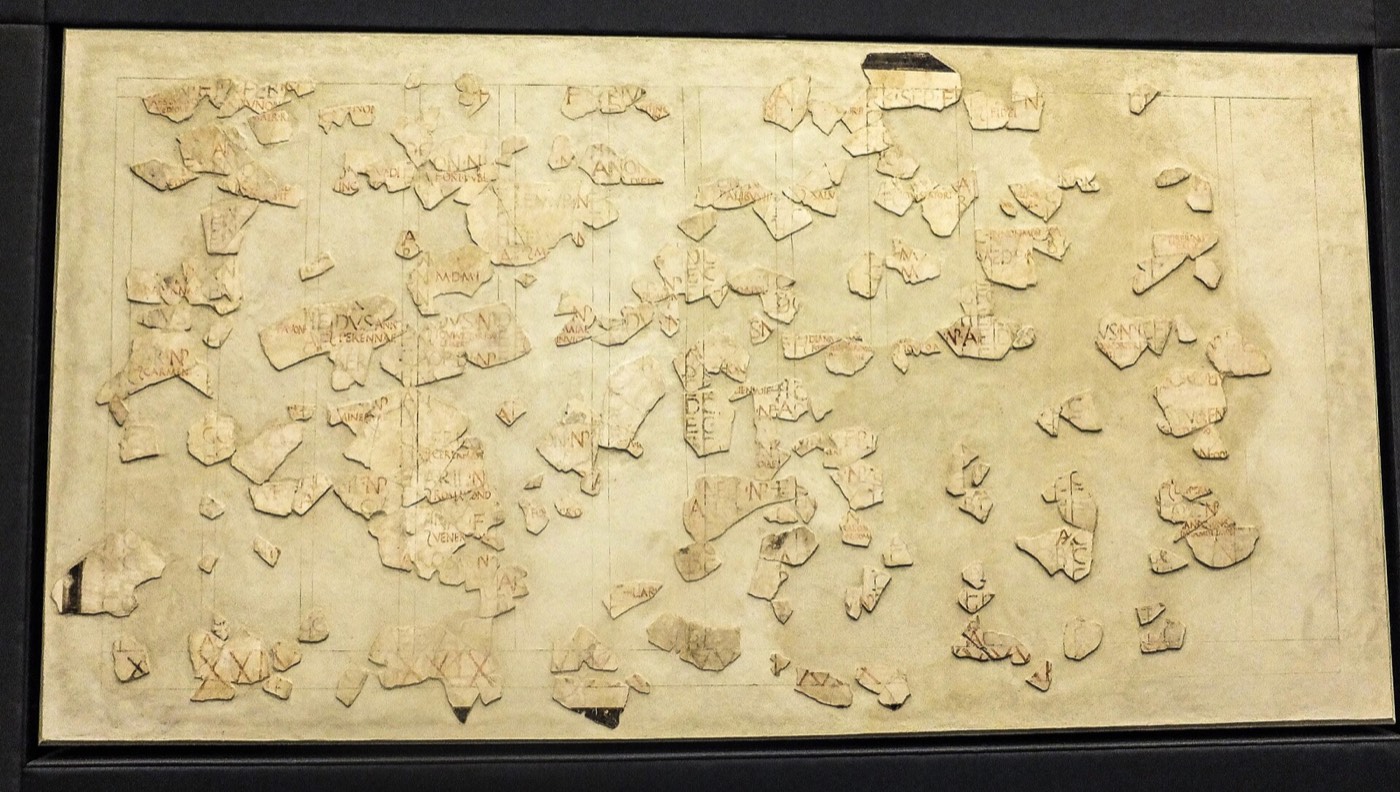
A calendar is a grid because people make promises about particular days.
A market on this day, a festival on that one, a debt due on the Kalends. The grid held obligations first; keeping it in step with the sun was a separate job, and a harder one. In 45 BCE Julius Caesar fixed the year at 365 days with a leap day every fourth year.
The seven-day week contains no astronomy at all. No moon, sun or season divides into seven. It came from the Jewish Sabbath and from the seven wandering lights of the sky, which still name the days in many languages. In 321 CE Constantine made Sunday a day of rest. On the right, the old market cycle runs against the new week and drifts across it, one column per week, as a diagonal.
Chapter VI 1088 · Kaifeng
The dial is a picture of the sky
So why a circle for the day? Look up long enough and the answer is overhead. Every star turns around the celestial pole once a day, and a camera left open on a clear night records the whole rotation as a set of concentric arcs.
Astronomers built instruments that copied the rotation. The astrolabe flattened the turning sky onto a brass plate you could hold.
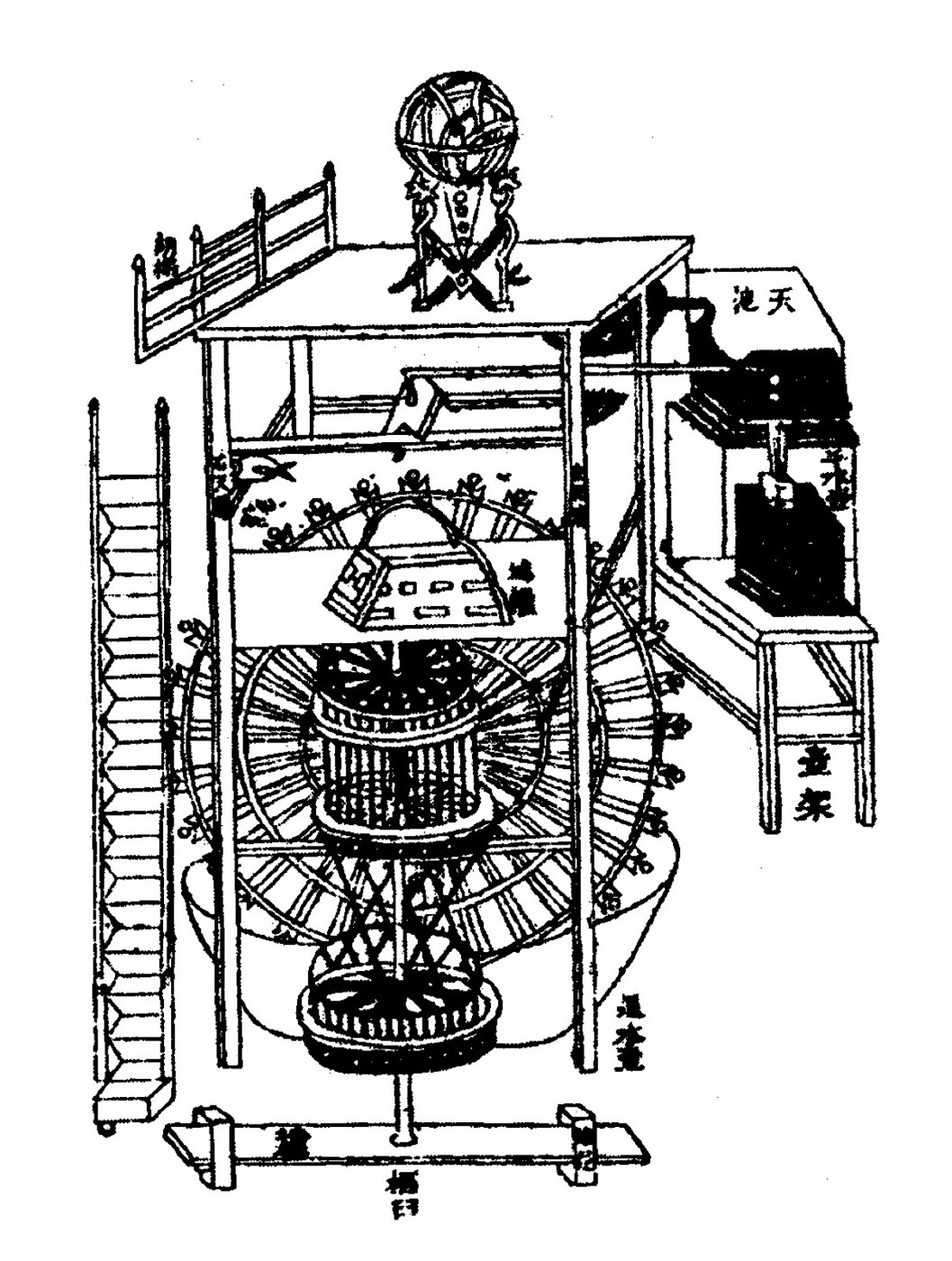
In Kaifeng, Su Song and his team finished a tower more than ten metres tall. A great water wheel, held back tooth by tooth by an escapement, turned a celestial globe in step with the heavens while figures rang bells and beat drums at the hours.
A clock face is a small, portable drawing of the night sky.
Chapter VII c. 1280 – 1400 · Europe
The first clocks had no face
The word clock comes from the medieval Latin clocca, a bell. The first mechanical clocks in European towers, from the late 1200s on, often had no face at all. They struck the hour, and that was the whole interface.
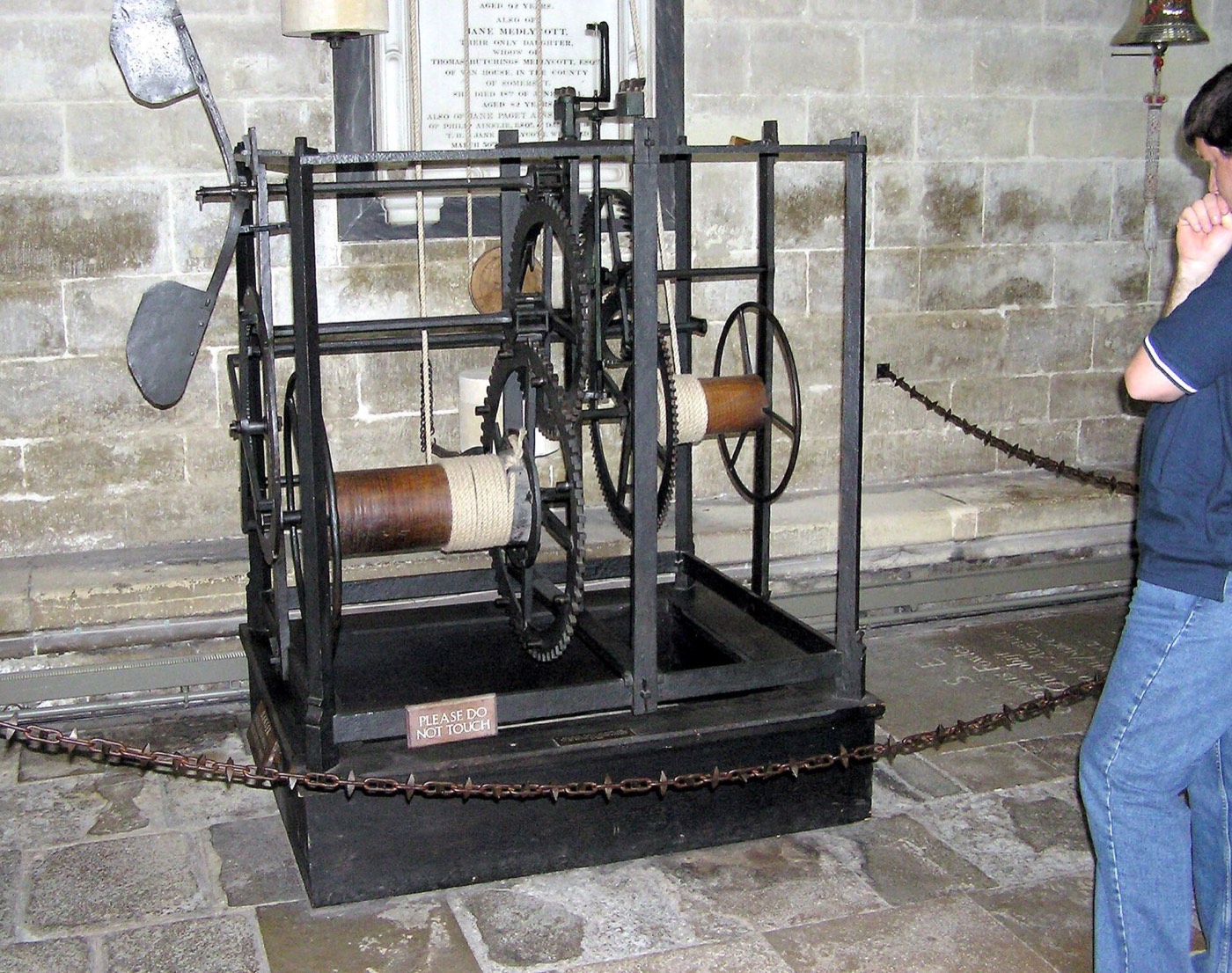
Monasteries wanted them first. The Rule of Saint Benedict ordered the day into fixed hours of prayer, through the night as well, and a machine that rang on its own in the dark kept the brothers on schedule. Within a century the same towers were ringing for markets, guilds and wages.
The heart of these machines was the verge escapement, a rocking catch that let a falling weight move one tooth at a time. It turned the smooth fall of a weight into countable beats.
The escapement made time countable, one tooth at a time.
The historian Lewis Mumford went as far as calling the clock, more than the steam engine, the key machine of the industrial age. What it produced was regularity, and a factory runs on that as much as on steam.
Every clock is an agreement about time that happens to be made of brass.
The argument of this essay
Chapter VIII 1582 · Rome
Ten days that never happened
Caesar’s calendar assumed the year lasts 365¼ days. The solar year is about eleven minutes shorter. Eleven minutes a year is nothing anyone would notice. Over sixteen centuries it adds up to ten days, and Easter had drifted away from the spring equinox it was meant to follow.
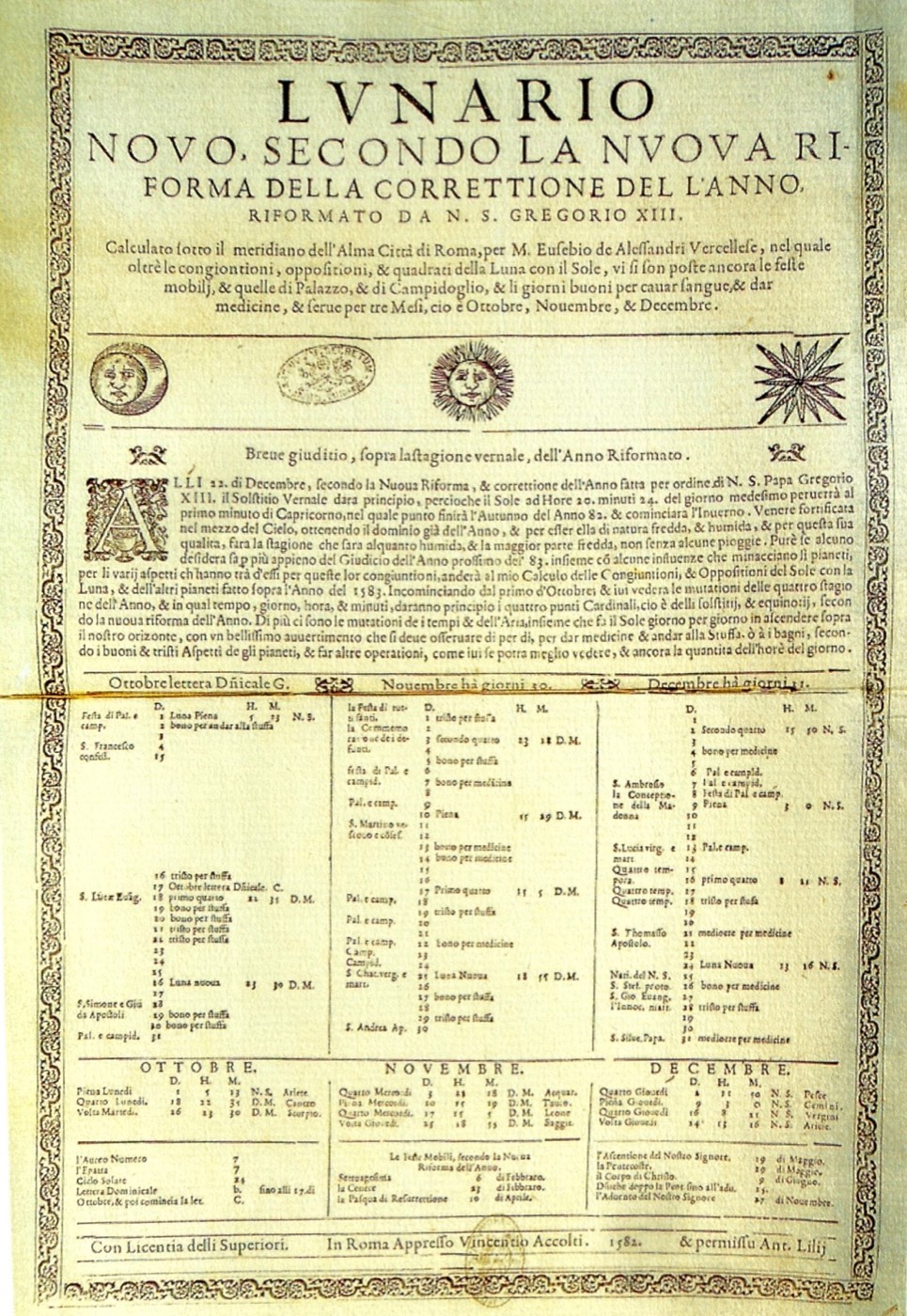
So in 1582 Pope Gregory XIII deleted ten days. In the Catholic states that followed him, Thursday 4 October was followed by Friday 15 October. The weekdays kept their order, so Thursday still led to Friday; only the date numbers jumped.
Britain and its colonies waited until 1752, when Wednesday 2 September was followed by Thursday 14 September.
A pope with a committee can delete ten days from the grid.
Chapter IX 1656 · The Hague
The minute appears
Galileo noticed that a swinging pendulum keeps almost the same beat whether it swings wide or narrow. In 1656 Christiaan Huygens built a clock around that fact. Good clocks of the day could drift by many minutes; a pendulum clock could hold to within seconds.
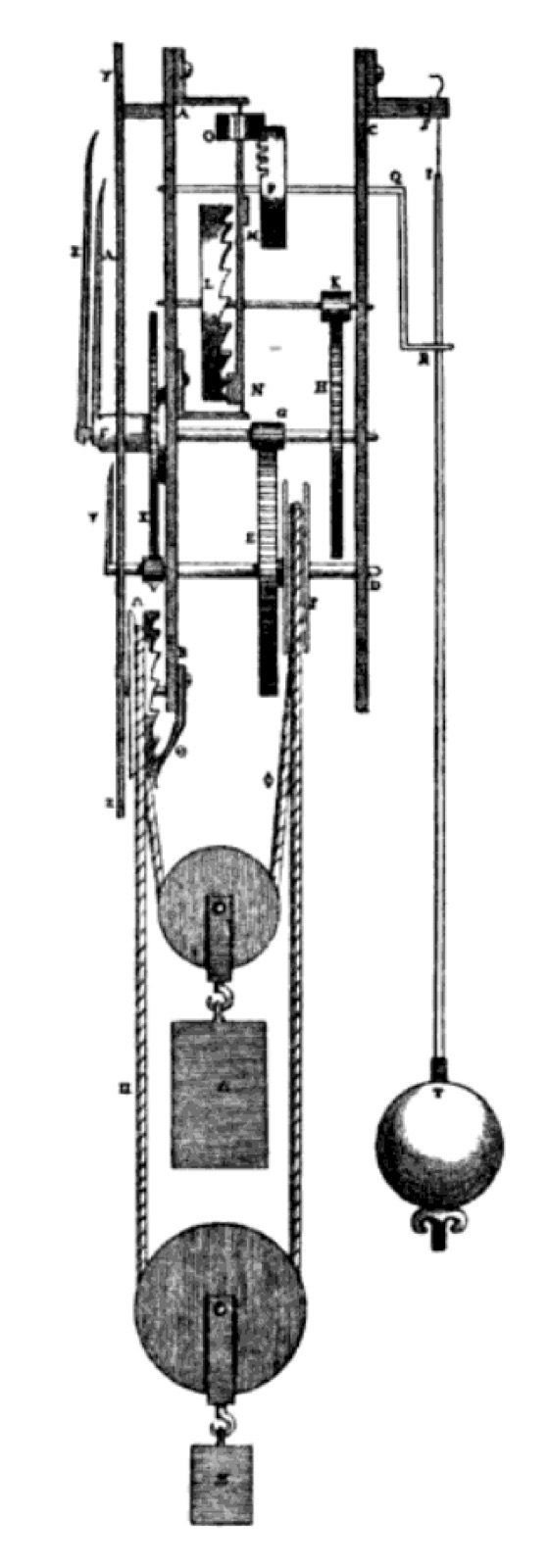
Only then did a minute hand earn its place. Many earlier dials had a single hand, since a second one would have promised a precision the movement behind it could not deliver.
The beat depends only on the pendulum’s length. Drag the weight on the right. At about one metre, each swing takes one second.
Precision changed work too. The historian E. P. Thompson described the shift from task time, the time it takes to milk the cows or bring in the harvest, to clock time, paid by the hour and checked by an overseer with a watch.
Once a clock could keep a minute, a minute could be owed.
Chapter X 1765 · London
Time became a line
The thin rule on the right edge of this page is a timeline. I drew it without thinking about it, and that is the point. The form is a lot younger than it feels.
In 1765 the chemist Joseph Priestley published A Chart of Biography: some two thousand lives drawn as horizontal bars across an evenly ruled scale of years. Before charts like his, history was mostly kept as lists, tables and branching trees.
One century to the inch. Somebody had to decide that.
Anyone who looked at the chart learned, without being told, that years are evenly spaced and run from left to right. The left-to-right part is borrowed from the way English is written. When researchers asked Hebrew and Arabic readers to put pictures in time order, many laid them out from right to left.
Chapter XI 1793 – 1795 · Paris
A rational day, refused
The French Revolution set out to make time reasonable. Its calendar had twelve months of thirty days, each split into ten-day weeks called décades, with the leftover days gathered at the end of the year. The day itself was to have ten hours of a hundred minutes, each of a hundred seconds.
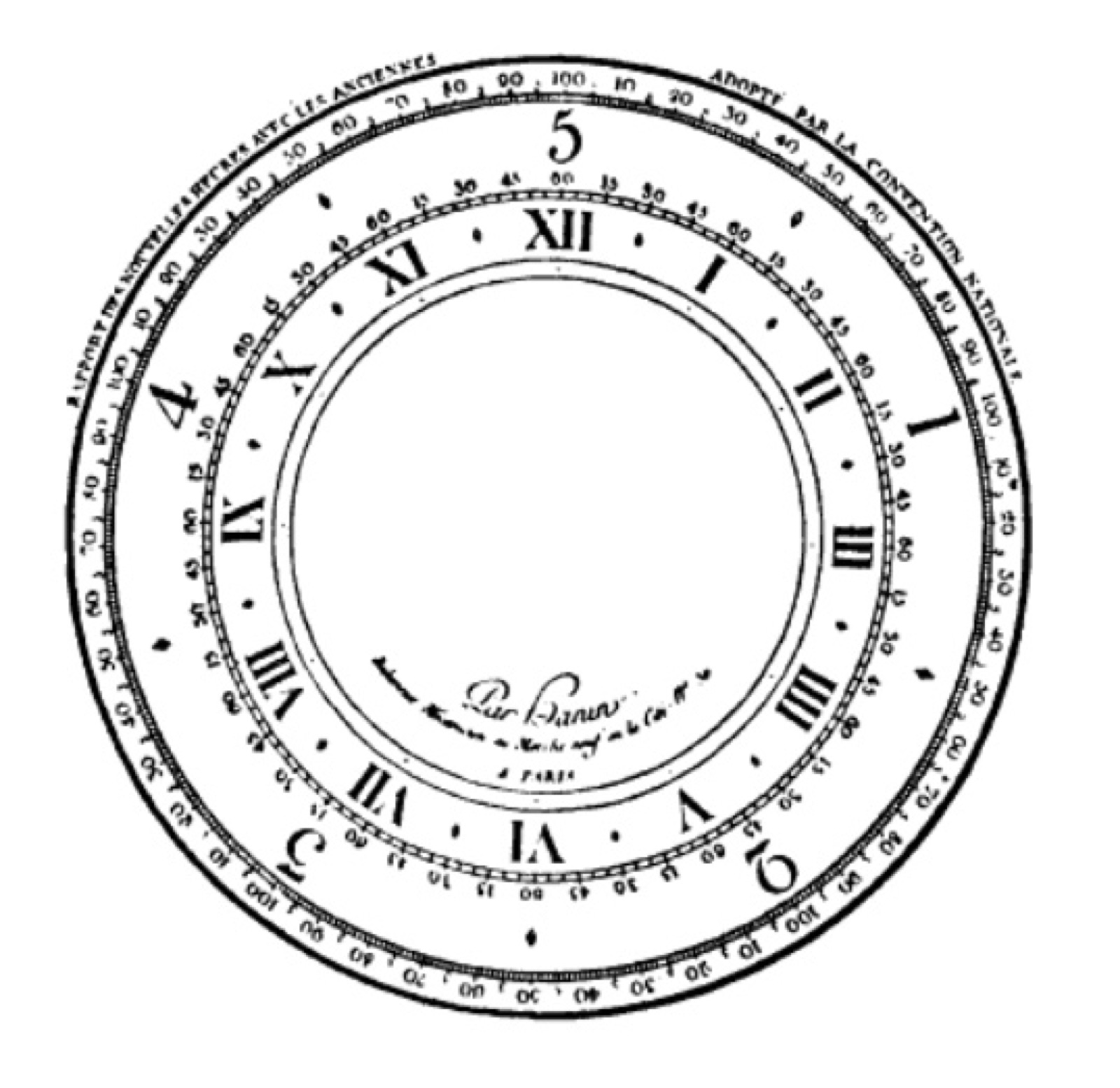
Clockmakers built dials for it, often showing both systems at once, as on the right. Decimal time was made compulsory in 1794 and suspended in 1795. The calendar lasted until Napoleon abolished it at the start of 1806.
The tidier system lost to the one people could already feel in their hands.
I find that an uncomfortable lesson, since I design things for a living. Twelve and sixty were never rational. They were familiar, and familiarity turns out to be a kind of infrastructure, laid down over centuries and expensive to dig up.
Chapter XII 1840 – 1884 · Britain, America
One shared now
Until the railways, every town kept its own noon, set by the sun overhead. Bristol sits about ten minutes behind London. Nobody minded, because nobody travelled fast enough for ten minutes to matter.
Trains changed that. In 1840 the Great Western Railway ran its timetables on London time, and in 1847 the Railway Clearing House urged every line to follow. The Corn Exchange in Bristol still has a clock with two minute hands, one for Bristol and one for London.
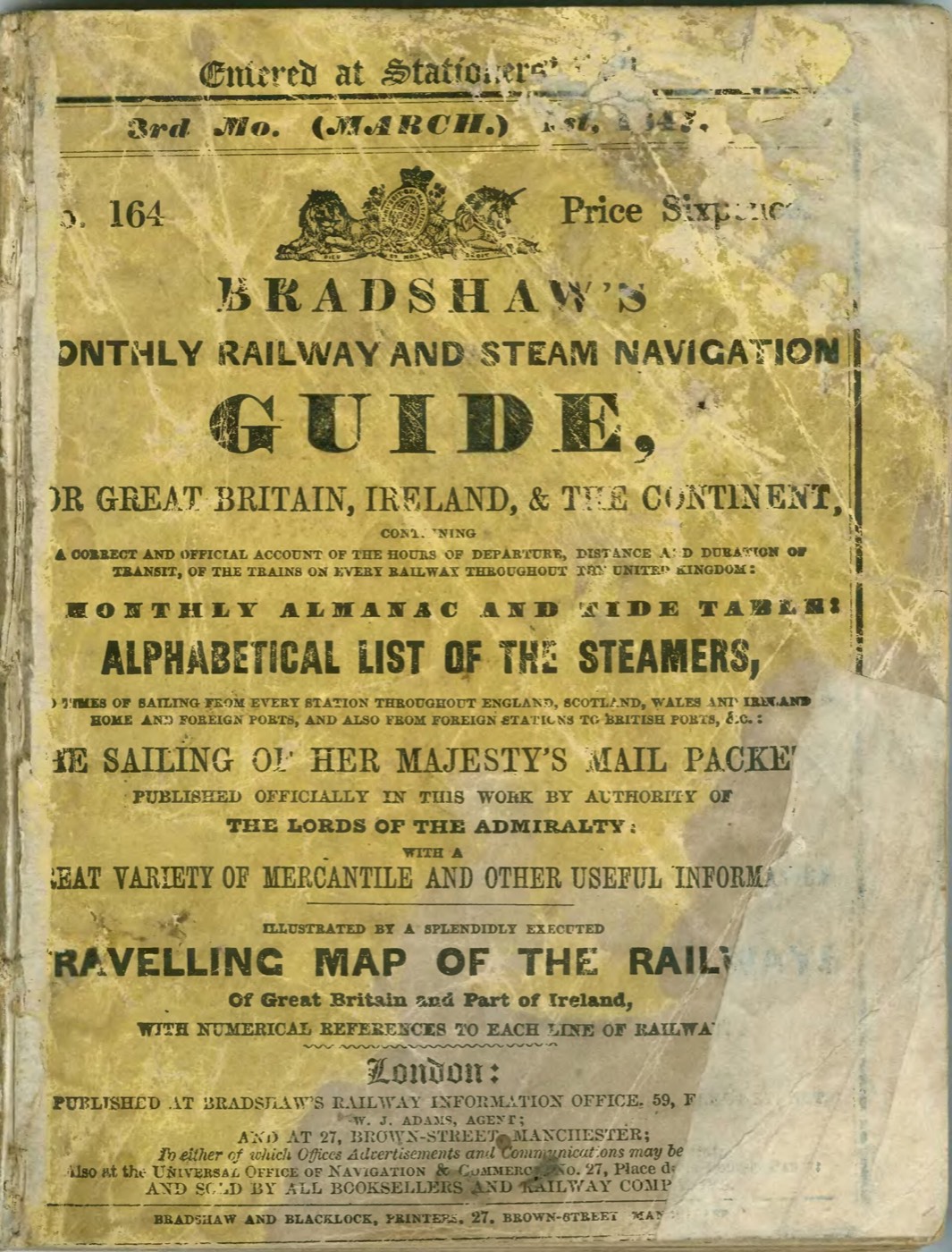
Britain made Greenwich Mean Time law in 1880. On 18 November 1883 the North American railroads switched to standard zones, a day newspapers called the day of two noons. In 1884, delegates in Washington chose Greenwich as the prime meridian of the world.
After 1883, the time in a town was whatever the railway said it was.
Chapter XIII 1905 · Bern
There is no single now
At the height of this rush to synchronize, a young examiner at the Swiss patent office in Bern spent his days reading applications for electrical inventions, including schemes to coordinate clocks at a distance. In 1905 Albert Einstein published a paper that begins with a plain question: what does it mean for two distant clocks to show the same time?
His answer was to send light from one clock to the other and back, and to define the meeting as halfway. Follow it on the right. The consequence took a while to sink in. Two observers moving relative to each other will disagree about which events are simultaneous.
The historian Peter Galison has shown how close the practical problem of railway and telegraph clocks sat to the theoretical one.
The world settled on one time in 1884. Physics withdrew it in 1905.
Chapter XIV 1967 · Paris
The second left the sky
For all of history the second was a fraction of the day, one part in 86,400 of a turn of the Earth. In 1967 it was redefined as 9,192,631,770 oscillations of the radiation from a caesium-133 atom. Scroll, and count one second.
Since 1967 the second belongs to caesium. The Earth is now the thing being measured.
Measured against the atom, the Earth turned out to be the sloppier clock. Its spin wobbles and slowly lengthens, so since 1972 timekeepers have added leap seconds to keep atomic time close to the sun. In 2022 they voted to stop doing that by 2035. From then on the clock and the sky will be allowed to drift apart.
First the sky went out of the second. Then the dial went out of the watch.
1972 onward
Chapter XV 1972 – today
The answer without the shape
In 1972 the Hamilton Pulsar showed the time as glowing red digits at the press of a button. The display kept the answer and threw away the dial it used to sit on.
Digits give you the position. A dial also gives you the distance, in both directions.
That may be why the circle survived the digits. Your phone tells the time in numerals, and the icon you tap to get there is still a round face with two hands. The number is enough to read; the shape is what we go by.
Chapter XVI Today · in every cell
The clock nobody designed
Almost every cell in your body runs a chemical cycle of roughly twenty-four hours. The 2017 Nobel Prize in medicine went to Jeffrey Hall, Michael Rosbash and Michael Young for finding its molecular gears. This clock was running long before anyone set a stick in the ground to watch its shadow.
The shape of time in the head is also less settled than our instruments make it look. Speakers of Aymara, in the Andes, talk and gesture as if the past lies ahead, where it can be seen, and the future behind. In Pormpuraaw, in northern Australia, people asked to order pictures in time laid them out from east to west, whichever way they happened to be facing.
Pick a way of being in time on the right.
Augustine lost his answer the moment someone asked. Sixteen centuries of better clocks have not found it.
Epilogue this minute
Now look again
This is what we inherited. A circle, because the sky turns and the day comes back. A grid, because people owe each other things on particular days. A line, because a chemist in 1765 drew history as a ruler. Each shape is an agreement, old enough that it no longer feels like one.
On the right is your day so far, counted the old way, one notch per minute.
Once you know where a shape came from, you notice what it is doing to you.
The sketches in Other Clocks swap the agreements around. I drew the day as a calendar and the year as a dial, to find out what each shape does to the feeling of time.
Sources and image credits
- Early clocks, seasonal hours, Karnak, Su Song. NIST, “A Walk Through Time”; M. A. Lombardi, NIST, “Why is a minute divided into 60 seconds?”
- Base sixty, minutes and seconds. NIST, “Second: Introduction” and timekeeping FAQs.
- Warren Field. V. Gaffney et al., “Time and a Place”, Internet Archaeology 34 (2013).
- Ice Age tallies. A. Marshack, The Roots of Civilization (1972); the lunar reading remains debated.
- Clockwise. NASA Goddard, “The Sundial”.
- Mechanical clocks, bells. The Met, “Notes on Time”; L. Mumford, Technics and Civilization (1934).
- Pendulum. The Met, “European Clocks in the 17th and 18th Centuries”; Science Museum Group, Coster clock c. 1657.
- Work and time. E. P. Thompson, “Time, Work-Discipline, and Industrial Capitalism”, Past & Present (1967).
- Timelines. D. Rosenberg and A. Grafton, Cartographies of Time (2010).
- Railway time, 1884. Royal Museums Greenwich; Statutes (Definition of Time) Act 1880.
- Einstein. P. Galison, Einstein’s Clocks, Poincaré’s Maps (2003).
- SI second, leap seconds. BIPM, SI Brochure; CGPM Resolution 4 (2022).
- Mind. R. Núñez and E. Sweetser, Cognitive Science (2006); L. Boroditsky and A. Gaby, Psychological Science (2010); Nobel Prize in Physiology or Medicine 2017.
- Images. Wikimedia Commons: The Met (CC0), L. Borchardt, Su Song, A. Pingstone, Amphipolis (CC BY-SA 2.0), Gregorian reform 1582, C. Huygens, Bradshaw 1847, French decimal dial. Full list in SOURCES.md.